Dirty Data, Drained Budgets: The Billion-Dollar Problem Most US Businesses Refuse to Acknowledge
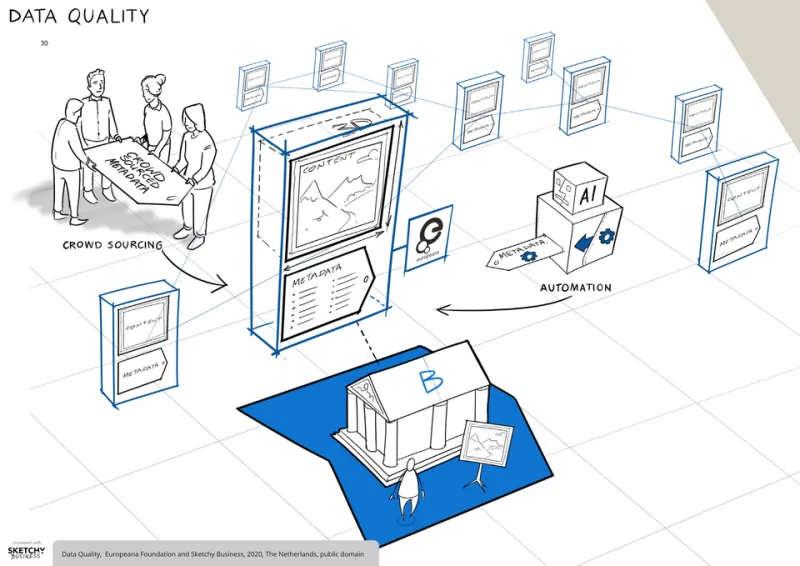
Photo: Europeana Foundation and Sketchy Business, CC0, via Wikimedia Commons
When the Numbers Lie, the Business Suffers
There is a quiet crisis unfolding inside the data warehouses and CRM platforms of American companies — and most leadership teams are completely unaware of its true scale. According to research from Gartner, poor data quality costs organizations an average of $12.9 million per year. IBM has placed the aggregate annual cost to the US economy at approximately $3.1 trillion. These are not theoretical figures. They represent real dollars lost to duplicated customer records, inaccurate sales forecasts, and marketing campaigns aimed at the wrong audiences.
At Adata Berna, we work with corporate clients across industries who consistently underestimate how deeply data quality issues are undermining their return on investment. The pattern is predictable: leadership invests heavily in analytics tooling, hires skilled analysts, and commissions sophisticated dashboards — then wonders why the insights aren't moving the needle. More often than not, the problem isn't the analysis. It's the underlying data feeding it.
The Many Faces of Bad Data
Data quality degradation rarely announces itself. It accumulates gradually, through routine operational friction — a customer who changes their email address, a sales rep who enters a deal value in the wrong field, a system migration that fails to reconcile duplicate records. Over time, these small inconsistencies compound into structural problems that distort every downstream decision.
The most common categories of data quality failure include:
- Incompleteness: Missing fields that leave critical context gaps in customer profiles or transaction histories.
- Inaccuracy: Values that were once correct but have since become outdated — addresses, contact details, revenue figures.
- Inconsistency: The same entity recorded differently across systems ("IBM Corp" vs. "I.B.M." vs. "International Business Machines").
- Duplication: Multiple records representing the same customer, lead, or transaction — often the result of siloed data entry across departments.
- Timeliness: Data that arrives too late to be actionable, or that reflects conditions from a prior business cycle.
Each of these failure modes carries a distinct financial signature. Duplication, for instance, inflates audience sizes in marketing platforms, driving up ad spend while simultaneously reducing targeting precision. Inaccuracy in sales pipeline data leads to resource misallocation — too many reps chasing low-probability deals, too few supporting the accounts most likely to close.
Case Study: The Retailer That Was Marketing to Ghosts
Consider the experience of a mid-sized specialty retailer operating across twelve states. Their email marketing program had grown to over 800,000 subscribers — a figure their CMO cited regularly as a key growth indicator. When the company conducted a thorough data audit, they discovered that nearly 31% of those records were either duplicated, contained invalid email addresses, or belonged to customers who had not made a purchase in over four years.
The practical consequence: they had been paying for email deployment, list management, and segmentation analysis on nearly a quarter-million records that would never convert. More critically, their engagement metrics — open rates, click-through rates — had been artificially suppressed by this dead weight, causing the team to undervalue campaigns that were actually performing well among active customers. Once the list was cleaned and re-segmented, deliverability improved by 22%, and the cost-per-acquisition on email-driven sales dropped by 18% within two quarters.
Case Study: The Manufacturer Whose Forecast Was Fiction
A regional industrial manufacturer relied on a combination of ERP data and manually maintained spreadsheets to generate quarterly demand forecasts. The disconnect between these two systems — updated on different schedules, by different teams, using different naming conventions — meant that the demand planning model was routinely working from figures that were weeks out of date.
The result was chronic overproduction in certain product lines and persistent stockouts in others. An internal review attributed roughly $4.2 million in excess inventory carrying costs over an 18-month period directly to forecast inaccuracy — inaccuracy that traced back not to modeling errors, but to the quality of the input data itself.
Why Most Companies Miss the Problem Until It's Expensive
Data quality issues are structurally difficult to detect because they often exist below the visibility threshold of executive reporting. Analysts work around known gaps. Sales operations teams build compensating logic into their models. IT teams patch inconsistencies at the point of integration. The cumulative effect is that leadership receives outputs that appear coherent — even when the foundation beneath them is fractured.
This is compounded by organizational incentives. Data governance is rarely glamorous work. It doesn't generate the same internal enthusiasm as deploying a new analytics platform or launching a machine learning initiative. Budget cycles tend to favor visible innovation over invisible infrastructure hygiene.
A Practical Checklist for Auditing Your Data Quality
For organizations ready to take the problem seriously, a structured audit is the essential first step. The following framework provides a starting point:
1. Inventory your data sources. Document every system that generates, stores, or transmits data used in business decisions. Include CRMs, ERPs, marketing platforms, financial systems, and any manual inputs.
2. Define quality dimensions for each source. For each system, establish what "good" data looks like across completeness, accuracy, consistency, and timeliness.
3. Profile your current data. Use data profiling tools (or engage an analytics partner) to generate statistical summaries of actual data quality across each dimension. Identify the gap between current state and defined standards.
4. Trace data lineage. Understand how data moves between systems. Where are transformations applied? Where do records get merged or split? Lineage mapping often reveals where quality degradation is introduced.
5. Quantify the business impact. For each identified quality issue, estimate the downstream business consequence. What decisions does this data inform? What is the cost of those decisions being made on flawed inputs?
6. Prioritize remediation by impact. Not every data quality issue warrants immediate attention. Focus first on the records and fields that feed your highest-stakes decisions.
7. Establish ongoing governance protocols. Data quality is not a one-time project. Define data stewardship responsibilities, implement validation rules at the point of entry, and schedule regular quality reviews.
The Strategic Imperative
The companies that will win the next decade of competition are not necessarily those with the most sophisticated analytics capabilities. They are the ones whose decisions are grounded in data they can actually trust. Investing in data quality governance is not a cost center activity — it is a revenue protection strategy.
At Adata Berna, we have observed consistently that clients who prioritize data integrity before layering on advanced analytics see dramatically better outcomes from those investments. The insights are sharper. The forecasts are more reliable. The strategic decisions are better calibrated to reality.
The question is not whether your organization can afford to address data quality. Given what poor-quality data is already costing you, the more pressing question is whether you can afford to wait any longer.